


Community as a System


How we think about anything will necessarily shape how we feel about it, and what occurs to us to do about it.
We are widely taught to break problems down into their respective components and look at them in isolation (and in a linear way). This can be helpful in breaking things down into manageable pieces. However, when we don’t zoom out and understand how those pieces fit into, and impact, the larger context then we often miss important information, which frequently leads to unintended consequences.
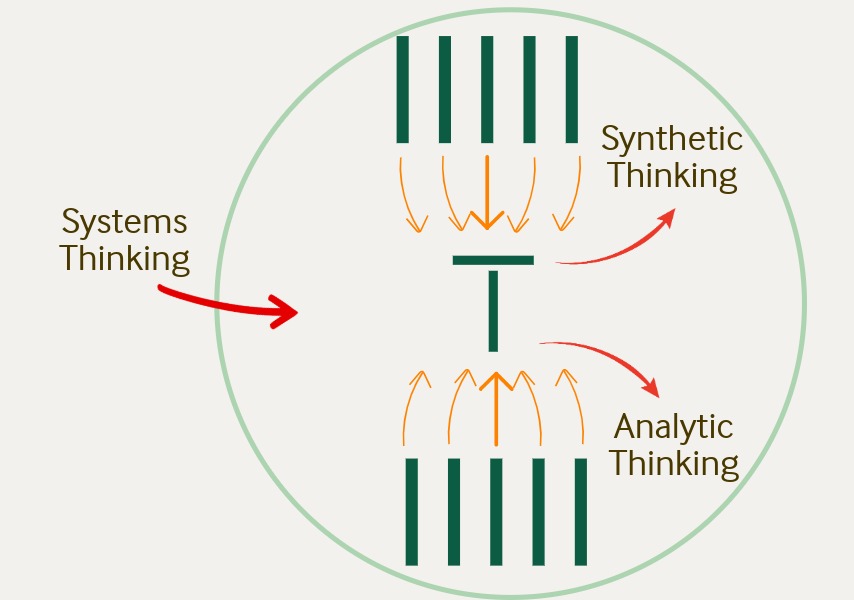
It is the difference between analysis and synthesis. Analysis breaks things down into parts to understand them, focusing on individual components and their relationships, while synthesis combines different ideas or parts to create a new, more complex whole, revealing broader patterns or a bigger picture. Analysis is deconstruction; synthesis is construction, often building upon analysis.
Systems thinking is the ability to combine both skills. It is the ability to see the forest AND the trees for a more complete understanding of what is really going on. Put another way, it combines deep, lived experience (worm’s eye view) with a broad, structural understanding (bird’s eye view) for comprehensive insight. For those of you who enjoy a visual, I give you this.
What does this skillset have to do with community? I am going to argue that it is important in reshaping how we think about it, and how we position ourselves within it. Most of us take an analytic approach to our understanding of this word. Meaning that we position ourselves at the starting point and splinter off from there into the communities of which we are a part. We are a part of a family, a part of a neighbourhood, a part of a special interest group or volunteer organization. Maybe you are involved in your kids’ school and feel a part of that community, or maybe you are on a sports team and that is a community for you. It could be a faith community or a book club or just a friend group. Your role and your needs in each of these communities is different and separate and distinct. We don’t often consider how they are subcommunities of a larger community and how each impacts the other.
What if instead we begin by recognizing that everyone and everything within a community—families, schools, businesses, government, nature, etc.—are linked, and a change in one affects all the others?
If we combined that worm’s eye view with a bird’s eye view and thought of our community as all of a city or country or even the world, what would change? What interconnections and opportunities could we see from that perspective? How could we avoid unintended consequences and empower local people to lead change by understanding their own impact and agency within these larger structures?
I will use a current issue that is on the minds of many of us these days to illustrate what I mean: homelessness (but any issue would work equally well). Tackled in silos, we think that the government (local, provincial, federal) is responsible for dealing with this problem, absolving ourselves of any responsibility (and also agency) to change it. But let’s try looking at it differently.
Homelessness isn’t just about a lack of (affordable) housing; it’s tied to economic instability, mental health crises, substance abuse, lack of education, systemic inequities, and many other things, all influencing (often exacerbating) one another.
As an individual we feel powerless to deal with the problem. We see homeless people as down on their luck and respond by giving them money to buy a sandwich (or not, for fear that they will spend it on something else). Conversely, we see them as a scourge on our streets that someone else should do something about. Either way we don’t see ourselves as part of the problem or the solution.
What if instead we all saw ourselves as part of the community and banded together so that our city (government, not-for-profit, schools, and individuals) used systems thinking to tackle homelessness by creating hubs that offered not just beds, but also integrated services: on-site mental health counselors, food security, rapid job placement programs, financial literacy classes, affordable housing navigators, a welcoming community to meet peoples’ social needs, all coordinated to support individuals on their path to stability, addressing the system, not just the crisis. In this way we all participate and bring the community together in these spaces, thus avoiding the siloing of the unhoused/homeless people from the rest of the community’s activities. When the whole community is involved in responding to these circumstances the relationships and social cohesion of the community get stronger – creating a virtuous reinforcing feedback loop. We then could create the systemic changes that would actually make the community better for all of us, rather than frustrating many of us with the intractability of band aid solutions that don’t seem to achieve anything and allow many of us to believe it is not our problem.
Now that is a community I can get excited about.

Reach Out
We love talking about what we do and how it can make a difference to you.