


Holding Opposites: On Paradox, Perception and Wisdom


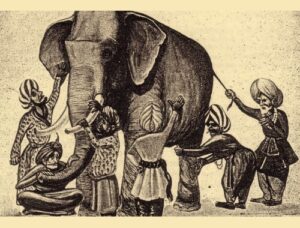
The parable of the Blind Men and the Elephant offers a powerful illustration of the limits of human perception. In the story, each blind man encounters a different part of the elephant and confidently proclaims the animal to be something else (a wall, a rope, a spear), mistaking a fragment of experience for the whole. The lesson is not that any one man is wrong, but that each is incomplete. Understanding deepens only when perspectives are shared and integrated, and the story warns us against the temptation to turn partial insight into absolute truth.
This wisdom echoes in the words of Jiddu Krishnamurti, who observed that “the ability to observe without evaluating is the highest form of intelligence”, and in F. Scott Fitzgerald’s claim that a first–rate mind can hold opposing ideas simultaneously without losing its capacity to function. Together, these reflections suggest that intelligence and wisdom are not about certainty or simplicity, but about the capacity to live comfortably with ambiguity, contradiction, and paradox.
This way of seeing is often called paradoxical thinking, the recognition that apparently opposing truths can coexist and even illuminate one another when held together. It is closely related to dialectical thinking, which moves beyond rigid “either/or” frameworks toward a more inclusive “both/and” understanding. Rather than choosing sides, it honors the possibility that multiple viewpoints may each contain valid insight.
Creative and divergent thinking are grounded in this same capacity. Children often demonstrate it effortlessly, seeing possibilities adults overlook. As we age, however, standardized education and testing frequently condition us to expect singular correct answers to complex questions. In doing so, we may trade imagination for certainty, and curiosity for control.
By contrast, systems thinking seeks to weave diverse perspectives into larger, more coherent wholes. Instead of rejecting difference, it treats it as essential. Meaning emerges not from uniformity, but from relationship, from how ideas, experiences, and viewpoints interact with one another.
Physicist Niels Bohr captured this elegantly when he noted that while the opposite of a correct statement is a false one, the opposite of a profound truth may be another profound truth. The nature of time offers a simple example. Because the Earth is spherical, half the planet is always in daylight while the other half is in darkness. At any moment, countless different times of day are being experienced simultaneously. Arguing over what time it “really is” would be futile. It is many times at once, and paradoxically, always the same moment: now.

Once I began to notice paradox in this way, it seemed to appear everywhere. Developing awareness is like acquiring a new lens: nothing outside changes, yet everything looks different. Attention acts as a filter, highlighting what was previously invisible. When perception shifts, patterns emerge across conversations, books, behaviors, and even our own inner dialogue.
Yet this too contains a paradox. Seeing something everywhere can feel like awakening, but it can also become a form of blindness. When one lens dominates, it risks oversimplifying reality, reducing complexity to a single explanation. Insight can quietly harden into ideology if it stops questioning itself.
Still, this phenomenon reveals something essential: reality is far richer than our default perception allows. Learning, in this sense, is less about accumulating new information and more about refining how we see, training attention to notice what was always present, waiting in plain sight.
My fascination with paradox stretches back decades. During my yoga teacher training, I was first introduced to the idea that objective truth may not exist. At the time, I rejected it as nonsensical. I understand it differently now. One of philosophy’s deepest paradoxes is that any claim to objective truth is always made by a subject, by a mind shaped by biology, language, culture, and experience. The moment truth is perceived or articulated, it is filtered through interpretation. Even the assertion that something is objectively true is itself a subjective act.

This does not mean that reality is meaningless or arbitrary. Rather, it suggests that truth is relational. It arises through the interaction between observer and observed. Different perspectives can reveal different, equally valid aspects of the same reality. Like the blind men and the elephant, no single viewpoint is complete, but none are necessarily wrong.
The paradox deepens when we realize that saying “there is no objective truth” sounds like an objective claim itself. This self-referential tension does not signal failure, but limitation, pointing to the edges of language and logic when grappling with complex reality. It calls for humility rather than certainty, and curiosity instead of dogma.
From this perspective, wisdom lies not in clinging to absolutes, but in remaining open. Open to dialogue, revision, and integration. Truth becomes less a fixed destination and more a process, evolving as understanding deepens.
At Common Earth, we spend considerable time exploring how thought shapes experience. Here, another paradox emerges: the human mind has access to fresh insight at any moment, yet it habitually replays the same thoughts again and again. While the mind is capable of creativity and imagination, it is also drawn to familiarity. What is known feels safer than what is new, even when the familiar is limiting or painful.
From both neurological and psychological perspectives, repetition is efficient. Habitual thoughts conserve energy and reinforce identity. Over time, these patterns solidify into mental grooves, and repetition begins to masquerade as truth. Yet every moment is genuinely new. Awareness itself is not bound to the past. Insight becomes available the instant attention loosens its grip on old narratives. Creativity, then, is not something we need to acquire, but something we must allow. When repetition quiets, even briefly, the present moment offers more than enough material for original thought.
This leads to yet another paradox: the tension between individuality and interconnectedness. It is easy to understand ourselves as separate, distinct beings; it can be harder to grasp that we are also deeply connected. Rumi expressed this beautifully when he wrote, “You are not a drop in the ocean. You are the entire ocean in a drop.” The individual is not insignificant, but a unique expression of a unified whole, the universe experiencing itself through countless forms.
I see a more intimate paradox playing out daily in my home with two teenage girls: the desire to blend in completely while simultaneously needing to feel special. At the heart of human identity lies this contradiction: you are entirely unique, yet not exceptional in any comparative sense. No one else has lived your exact life, yet your joys and fears echo those of billions who came before and after you.
The paradox resolves when we stop treating specialness as a competition. Uniqueness does not require superiority, and ordinariness does not erase meaning. No leaf is more valuable than another, yet no two are the same. Both truths coexist.
Holding this paradox can be liberating. You are freed from the burden of being extraordinary in order to matter, while still honoring the dignity of your singular perspective. You matter not because you stand above others, but because you are here, this particular expression of life, happening once.
Paradox appears even in practical domains. In energy systems, the Jevons Paradox describes how increases in efficiency can lead to greater overall consumption rather than less. What seems like progress produces unintended consequences, reminding us that linear thinking often fails to account for complex systems.
Albert Camus framed absurdity in a similar light. For him, the absurd arises from the clash between humanity’s hunger for meaning and a universe that offers none. It is paradoxical because it both makes sense and doesn’t. We expect coherence, and reality refuses to comply.
Absurdity can feel tragic or humorous, sometimes both at once. In each case, our assumptions are exposed as provisional. Yet for Camus, the absurd is not despair. It is freedom. When meaning collapses, we are released from defending fragile certainties. We can live, choose, and create not because life makes sense, but in full awareness that it does not.
To name something absurd is not to dismiss it. It is to acknowledge that meaning and meaninglessness are intertwined, and that living fully may require holding both without resolution.
So I’ll end with an absurd paradox that feels especially personal as I approach another birthday: you don’t become cooler with age, but you do care progressively less about being cool – and that is the only true way of being cool. This, I’ve decided, is the Geezer’s Paradox.

Reach Out
We love talking about what we do and how it can make a difference to you.