


When the World Heats Up, How Do We Respond?

Two years ago, I wrote “A Sizzling 2024 Awaits” while watching winter turn to rain in Whistler, one of Canada’s most iconic ski towns. I wrote about methane, ‘weather whiplash,’ the unintended consequences of falling aerosol emissions, and the oceans absorbing unprecedented heat.
A sizzling 2024 did indeed arrive – the warmest year ever recorded with 2025 following closely behind. Yet around here the familiar questions persist:
“Will it be a good season?”
“Are we going to get good snow?”
We talk about winter as though nature owes us certain conditions and that we are customers of the planet rather than participants in it. But that framing feels thinner each year. Something deeper is shifting.
Grief, Again
In that earlier piece, I compared climate grief to losing my mother – the bargaining, the urgency, and then the tenderness of acceptance.
That emotional mix remains. But lately, it’s joined by a subtle change in disposition: away from the urgency to force solutions and toward being present with what is. It feels counterintuitive given the gravity of climate change, yet systems thinking often reveals this paradox – our first impulses in crisis aren’t always our wisest.
This shift isn’t resignation. It’s a change in how we meet what’s changing – less about fixing, more about how we live alongside it, with steadiness and care.
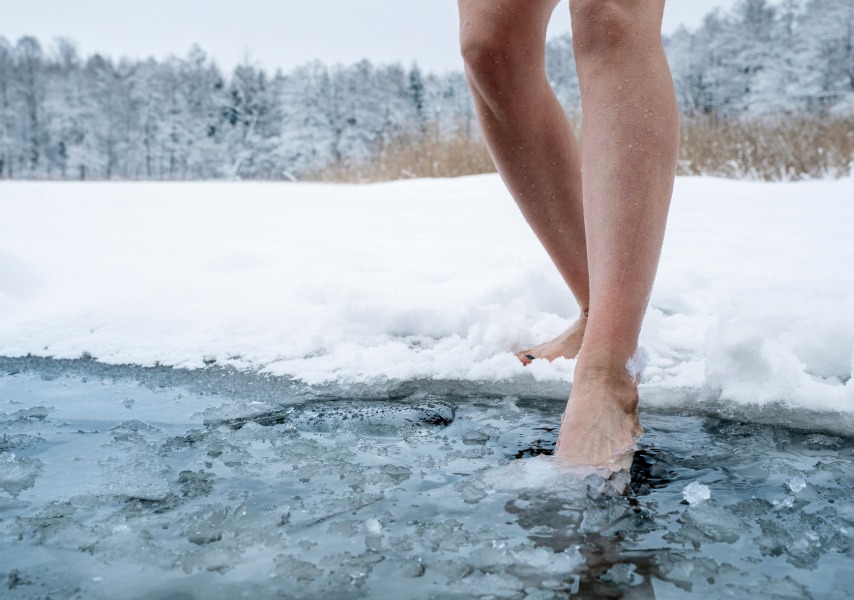
Unexpectedly, I found this reflected in cold-water plunging. I used to approach it as something to master – the same way we often treat climate change as a problem to fix rather than a relationship to tend. My body resisted the cold water almost violently. But recently, encouraged by friends, I’ve been entering slowly. Not conquering the cold but meeting it through my breath. The water hasn’t changed, but my way of being with it has. It’s a reminder: conditions don’t need to improve before something in us can soften. Presence can coexist with discomfort. Cold water hasn’t made the world easier, but it has invited a different way of being with what is.
From Head to Heart to Hands
Climate awareness often begins intellectually – statistics, models, projections. Important, yes, but when knowledge stays in the mind, it keeps us at a distance from what it is asking of us.
A shift in disposition lets knowledge settle differently – not as data, but as relationship. Like threads in a fabric, thought weaves with feeling, feeling influences action, and action reshapes understanding. None of these threads work alone.
When understanding touches both heart and mind, action stops trying to control the world and becomes a way of caring for it. And care often shows up in very ordinary places including in our relationship to our food.
The Taste of Care
A friend recently described eating a croissant somewhere in Europe – flaky, rich, honest in its ingredients. Not marketed as healthy or optimized. Simply cared for in its making. Even the coffee that accompanied it seemed to hold the same attention. It may not check any nutritional boxes, but it nourished something else entirely – the way quality, intention, and time feed more than the body. When we slow down, we can taste care.
We talked about how food changes when we participate in it – not through ideology, but responsibility. When food comes through effort and intention, we don’t rush or waste it. You can’t take more without feeling the weight of what you’ve taken.
I saw this in my son when he went crabbing with a friend and his father a few years back. He learned how to tell which crabs to throw back to protect the population, how to prepare the one they kept, and finally how to eat it. It was one of the best meals of his life – not just because of flavor, but because participation made it whole. The shared effort, the restraint, the respect, the storytelling – it fed something deeper. Like a woven fabric, it involved his head, his heart, and his hands. Care fed more than hunger.

The Care of Childhood
This kind of care feels familiar, and many of us knew it in childhood. Growing up in a small town in the 1980s, I remember a freedom that was spacious. We built forts, invented rules, and in the winter, we watched the fjord closely, hoping for it to freeze solid enough to skate on. When it finally did, patience was nowhere to be found. We tested the ice long before any sensible adult would have approved. Once, I fell through and was pulled out by friends. We ran home soaked and laughing, boots sloshing like buckets. No adults hovered, yet we weren’t alone. Care lived in the culture, not in control. Perhaps that’s why a series like Stranger Things resonates even with kids who never lived through the 80s. Set around a group of unsupervised children navigating danger, friendship, and mystery together, the show centres on loyalty, curiosity, and shared risk rather than constant adult oversight. It’s not nostalgia for cassette tapes – it’s the ecology of trust: danger without panic, freedom with loyalty, and uncensored discovery.
Today, I don’t know a parent who wouldn’t want to give their child more freedom. Most of us sense how valuable it is. Yet even when we try to loosen our grip, the system around us tightens it. Where I live, most children spend their afternoons in organized activities, not because parents dream of packed schedules, but because the way life is structured almost demands it – school hours, work hours, safety concerns, competitive pressure, streets designed for cars and not kids. We don’t always choose to manage childhood – perhaps it is rather that we feel managed by the conditions we’re living in.
And here is where it becomes deeply systemic. The same cultural forces heating the planet – speed, distraction, extraction, convenience-at-any-cost – are also shaping childhood. Over-scheduling, screen-saturated lives, consumerism, declining mental health. These are not random issues. They mirror a system designed for efficiency, consumption, and stimulation rather than care.
A world that treats ecosystems as resources to optimize eventually treats childhood the same way. The logic of extraction causes ecosystems break down – whether those ecosystems are forests, oceans, or the inner lives of young people. We don’t need to assign blame to see the structure.
These are big topics, and I don’t pretend to know the answer. Certainly, it is easy to feel overwhelmed the more we recognize how entangled our predicament really is as these experiences don’t line up into a neat sequence or a five-step roadmap. Reality rarely works in straight lines.
So instead of offering instructions to follow, what if we instead asked ourselves to consider the disposition from which we do respond – less focus on what we do and far more on how we meet the world we’re in.
Care Is Our Unifier
Whatever 2026 holds – more rain or a sudden snowfall, more headlines about heat, more overwhelm, more beauty, more contradiction – we will still be asked to respond. But perhaps the invitation is not to fix faster, optimize harder, or control more tightly. Perhaps the invitation is to meet what comes with a steadier kind of participation.
To move through the year the way we might enter cold water: not bracing, not conquering, but paying attention to how we arrive.
To eat like participants rather than consumers – tasting the work and savoring the reciprocity in what feeds us.
To leave room in our lives – both adults and children – for discovery rather than management, for relationship rather than achievement.
To let understanding move through head, heart, and hands, not as a plan, but as a way of being in relationship to a changing world.
Whatever choices this year asks of us – in our homes, our communities, our organizations, our politics – maybe we can begin with this question:
From what disposition am I responding?
A subtle change of posture that makes room for responsibility, attention, and care in how we inhabit the world we’re shaping and passing on to our children.
In a heating world, that might be one of the most meaningful responses we have.

Reach Out
We love talking about what we do and how it can make a difference to you.