

Turning the Kaleidoscope – What becomes possible when we relax the grip
At the beginning of this year, I wrote an article called When the World Heats Up, How Do We Respond? I explored what it might mean to meet a changing world with greater attention, participation and care both in terms of how we relate to ourselves, each other and the world around us. I ended it wondering what 2026 might hold – more overwhelm, more beauty, more contradiction – and what difference it might make if, in the midst of whatever came our way, we remembered to ask ourselves: From what disposition am I responding?
Three quarters into 2026, the challenges we face don’t seem to have become any less gnarly. Wars and geopolitical tensions continue to reshape lives and economies. AI is developing at extraordinary speed and across the summer, heat, fires and other extreme weather have again reminded us that climate change isn’t waiting politely for us to figure everything else out.
My own little corner of 2026 has had its share of complexity too and at times forced me to explore questions I might otherwise have been perfectly happy leaving at the philosophical level. It turns out that asking “From what disposition am I responding?” is considerably easier when life is cooperating.
When it isn’t, it is easy to get caught in a “thought storm,” where one thought reinforces another until whatever version of reality we have constructed in our minds start to feel very solid. Possibilities narrow, the feeling of being stuck grows, and the walls begin to close in.
I grew up in the 1980s as the little sister of two older brothers, so Star Wars was a significant part of my cultural education. In the very beginning there is a scene where Luke Skywalker, Han Solo, Princess Leia and Chewbacca are trapped in a garbage compactor and the walls literally begin closing in on them. THAT is sometimes a remarkably accurate representation of my 3 a.m. experience.
Fortunately, life has also taught me that the walls will move out again. When I stop trying so hard to figure everything out, my mind eventually settles on its own. Sometimes it helps to write, go for a walk, listen to music or talk to someone I trust. Sometimes I just need to sleep! The common thread seems to be that my grip relaxes a little and I naturally settle back into a steadier sense of myself. Some call it our wise self, our core, our essence – I am not sure the name matters very much. I know it more by how it feels – like coming home. Fear loosens its grip, giving way to an undercurrent of safety, spaciousness and, most of all, love. Openness, curiosity and possibility return even though the situation itself may not have changed and from this steadier place I often see something I couldn’t before.
There is a curious paradox here: the more secure I feel in myself, the less I seem to need certainty about what happens next. Uncertainty begins to feel less like something I need to resolve and more like a space in which possibilities I haven’t yet imagined can emerge.
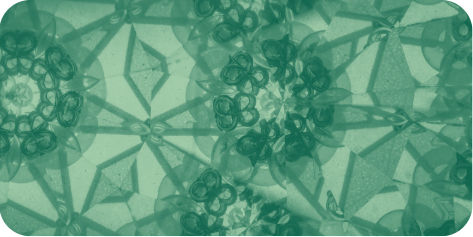
This brings me to one of my favorite metaphors: a kaleidoscope. Give it the tiniest turn and the same collection of colored pieces falls into an entirely different pattern. Nothing has been added or removed, and yet suddenly you are looking at something new.
I think something similar happens when we find our way back to that steadier place within ourselves. We don’t necessarily have new information or different circumstances. What changes is that we are no longer holding on quite so tightly to one interpretation of what is happening or where it must lead. When we loosen our grip and relax, new ways of seeing the situation and what might happen next, have room to emerge and in that little bit of space, the kaleidoscope can turn.
Widening the Picture
Perhaps one of our difficulties is that we tend to become very attached to whatever part of the picture is immediately in front of us. It can happen in a disagreement with a partner or colleague just as easily as in the much bigger debates around climate, immigration, politics, war, gender or AI. We easily become convinced that our version is the version, which can quickly collapse complexity into opposing positions: right or wrong, for or against, good or bad.
There are good evolutionary reasons why we are drawn to such distinctions. For most of human history, we lived in small bands where our survival depended on the people around us. Who we could trust, cooperate with and rely on, and who or what might pose a threat. But we now live on a radically different scale. More than eight billion of us are interconnected through economies, technologies, supply chains, ecosystems and institutions that span the planet.
At the macro level, our vastly expanded scale changes things in at least two important ways. First, our actions can affect people and places we may never see. In smaller communities, what people did – and its impact on others – was often much more visible, creating natural forms of social accountability. At today’s scale, that connection is easily obscured.
Second, what looks like the action of one person, company or country is often shaped by relationships, incentives and feedback loops stretching across a much larger system. This wider view is at the heart of systems thinking – looking beyond what is immediately in front of us to understand the structures shaping behavior and, ultimately, the assumptions and ways of thinking beneath them.
And of course, those systems are made up of humans. The same tendencies that shape how we respond in our own lives – how we react to uncertainty, perceived threat, opportunity or one another – don’t disappear at scale. They interact with institutions, incentives and technologies, sometimes becoming patterns far larger than any one of us.
Survival Strategies in an Artificial Intelligence Race
AI offers a fascinating example which I recently was discussing with my oldest son. To him, the extraordinary speed of AI development was quite obviously an arms race: companies and countries competing to stay ahead, each making it harder for the others to slow down. Seen through a wider lens, the behavior makes sense. Competition for resources, security, status and advantage is hardly new – it has been part of how humans have navigated the world for a very long time.
But the conversation didn’t stop there. My son pointed out that some of the very people leading the arms race, are also calling out for greater regulation and oversight. In addition, others have left senior positions and spoken publicly about their concerns. These discussions and departures are themselves feedback into the larger system, increasing visibility and pressure for accountability – and potentially changing what happens next.
They also reveal something equally fundamental about humans. We evolved not only through competition, but through cooperation – two deeply rooted survival strategies that AI brings into particularly sharp relief. For now, competition is clearly the dominant force driving its development. Yet the very technology we are racing to develop has also raised concerns about risks to our collective future, creating a powerful reason for that other survival strategy to come into play: cooperation. We can already see glimpses of it in calls for shared rules, greater oversight and forms of collaboration that recognize that some risks cannot be navigated by any one actor alone.
Those responses are not separate from the system – they become part of it. Calls for regulation, public debate, people choosing to speak out or leave influential positions, and attempts to create shared rules all feed back into the conditions in which artificial intelligence development unfolds. We cannot know where any of this will lead. Systems are always in motion: we act, others respond, conditions shift, and new possibilities emerge that weren’t visible from where we started.
Which brings me back to my 3 a.m. rabbit holes…
Putting Ourselves Back in the Picture
We are not standing outside the systems we are trying to understand – we are part of them. Everything we bring to a situation – including our internal state – shape what we notice, how we interpret it and how we respond which, in turn, becomes part of what happens next.
When we feel threatened or unsettled, our view can narrow and possibilities disappear – but from a more grounded and secure place, we may see something that wasn’t visible to us before. And how we respond from either place becomes part of what happens next as it changes not just our own experience of the situation but also how we participate.
Think of an interaction you’ve had when you felt grounded and secure, rather than unsettled or defensive. How did that change the way you showed up? What you noticed? How you listened? What you were able to hear? Perhaps you were less concerned with defending your own position and got curious about the other person’s. Perhaps the conversation went somewhere it might not otherwise have gone. This is part of what it means to recognize ourselves as being within the systems we are trying to understand. What we bring to an interaction shapes how it unfolds and therefore what becomes possible next.
The kaleidoscope turns between us.
We may not agree, but that isn’t really the point. The interaction itself has shifted something. I may see something I couldn’t see before, and perhaps you do too. Different responses become possible, which in turn may open possibilities neither of us could have anticipated. We cannot know exactly where any of it will lead, but our worlds have expanded rather than contracted.
That is at least what I am learning in my own little corner of 2026: finding greater steadiness doesn’t make complexity disappear or tell us what happens next. But it can loosen our grip on the version of reality we had, at least momentarily, become certain was true, allowing more of the picture to come into view. And when we see more, more possibilities become visible too – not only in how we understand what is happening, but in how we might respond and what that response might make possible next.
We see more, while holding what we see more lightly. We work with what we can see without assuming it is all there is. We recognize ourselves as participants in systems that are continually moving and responding, and remain open to what we cannot yet see.
And possibility doesn’t only emerge from what changes within us. It also emerges in the space between us – through dialogue, cooperation and the ways we respond to one another. I show up differently, you respond, something shifts, and something may emerge that neither of us could have fully anticipated.
The pieces may be the same.
But the kaleidoscope has turned.
And suddenly, a different pattern is possible.
Reach Out
We love talking about what we do and how it can make a difference to you.